Description
This eLearning module offers a guide to the four critical stages of the digestive system: ingestion, digestion, absorption, and elimination. Tailored for Nutrition students, the course transforms complex anatomical concepts into a clear, sequential learning path, and ensures students understand the entire digestive process, concluding with a targeted quiz to verify comprehension of the material.
Role: Designer


The goal
To simplify complex physiological mechanisms into a clear, visual, and interactive learning experience for nutrition students mastering human digestive anatomy.
By mapping the step-by-step breakdown and absorption of nutrients across the gastrointestinal tract, the guide enables future nutritionists to build strong foundational clinical knowledge—helping them accurately connect digestive mechanics to dietary planning and therapeutic nutrition.
Learner Profile

Demographic & Educational Context
-
Target Audience: Undergraduate or introductory-level Nutrition and Dietetics students (as well as pre-health or nursing students taking nutrition coursework).
-
Academic Level: First- to second-year university students.
-
Context: Enrolled in foundational courses like Human Anatomy & Physiology, Basic Nutrition, or Nutritional Biochemistry.
Prior Knowledge & Baseline Skills
-
Current Knowledge: Understands basic biological concepts (cell structure, basic chemistry, primary food groups) but lacks a cohesive, systemic model of how physical breakdown, chemical enzymatic activity, and nutrient absorption interconnect across the GI tract.
-
Common Conceptual Friction:
-
Difficulty visualizing abstract, sub-microscopic processes (e.g., brush border enzyme activity, micelle formation, sodium-glucose cotransport).
-
Struggles to retain the sequential timeline of chemical secretion (hormones, enzymes, and sphincters) relative to specific anatomical landmarks.
-
Key Motivations & Career Goals
-
Academic Success: Wants to master foundational physiology to pass high-stakes board exams, clinical assessments, and upper-level coursework.
-
Clinical Application: Driven to understand why digestion breaks down in pathological conditions (e.g., IBS, celiac disease, malabsorption) so they can eventually design effective, client-centered medical nutrition therapies.
Learning Preferences & Technical Needs
-
Visual & Structural Learners: Prefers highly visual, interactive representations over dense, textbook-style descriptions to grasp spatial relationships and sequential physiological flows.
-
Study Style: Uses study tools for quick reference, self-testing, and step-by-step revision on laptops and tablets outside the classroom.
Learning Objectives
By the end of this digital guide, nutrition students will be able to:
-
Anatomical & Sequential Tracking: Trace the step-by-step pathway of food through the six main organs of the GI tract, identifying the key anatomical landmarks and sphincters that regulate mechanical movement.
-
Chemical Breakdown Mapping: Identify the primary organs and glands responsible for digesting carbohydrates, proteins, and lipids at each stage.
Core functionality
-
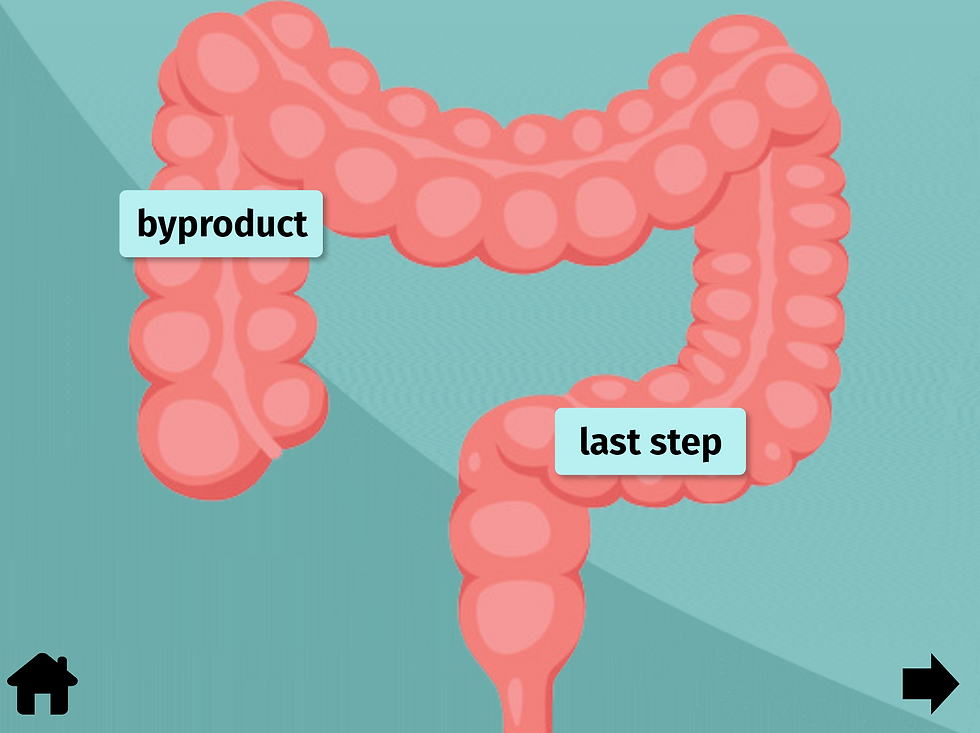
Four-Stage Learning Path: Dedicated modules covering Ingestion (mouth/esophagus), Digestion (stomach), Absorption (small/large intestines), and Elimination.
-
Anatomical Mapping: Interactive identification of key organs, explaining their specific contributions to nutrient breakdown.
-
Physiological Insights: Detailed explanations of mechanical processes like peristalsis and chemical processes involving enzymes and gastric acids.
-
Knowledge Validation: A summative end-of-course quiz featuring multiple-choice and identification questions to verify retention of the material.
-
Resource Library: A quick-reference guide for students to revisit specific organ functions or digestive milestones during the quiz.


Images of End product