Description
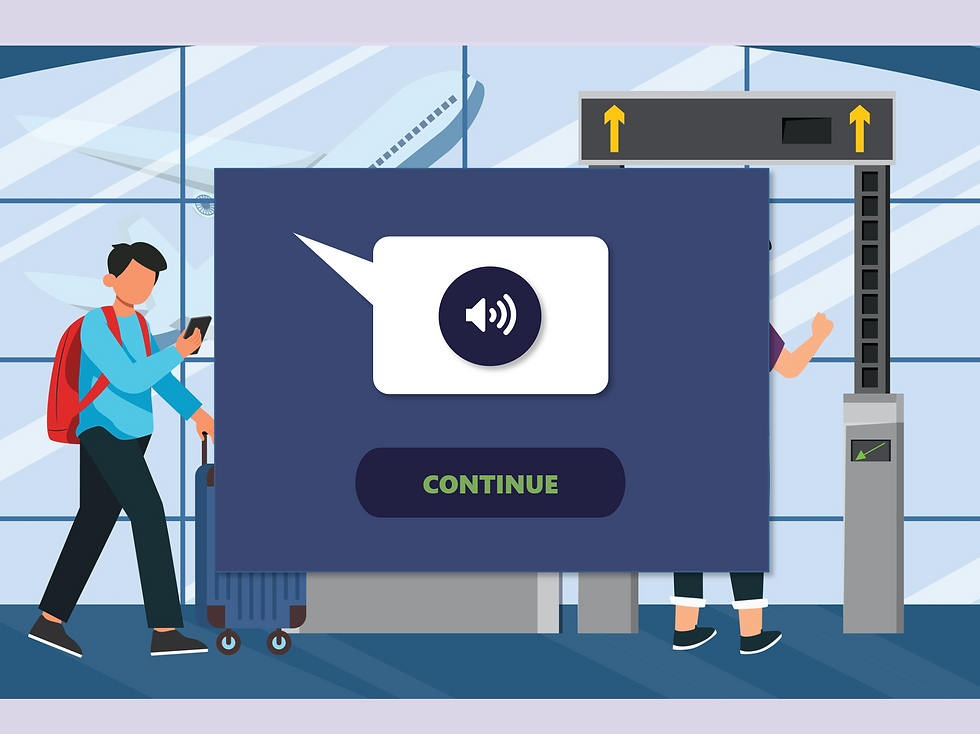
This interactive eLearning experience places students in a virtual airport to help them navigate common travel hurdles—such as passing through security or verifying flight details—using audio-driven prompts. By simulating the specific tasks and environmental pressures of international travel, students must use active listening to make decisions, sort items, and confirm information, ensuring they are prepared for the linguistic demands of their next trip.
Role: Instructional Designer, Teacher, Voice actor


The goal
To reduce travel-related anxiety and increase operational self-sufficiency for non-native English corporate professionals when navigating international airports.
By mastering key situational vocabulary, auditory comprehension, and real-time communication under pressure, learners can independently manage every stage of airport transit—from check-in to customs—ensuring smooth, confident business travel.
Learner Profile

Demographic & Background Context
-
Role / Position: Mid-to-senior level corporate employees (e.g., Project Managers, Consultants, Account Managers, Regional Leads).
-
Age Range: 28–54 years old.
-
Native Language: Spanish (native or bilingual equivalent).
-
Workplace Context: Works in a multinational company or a domestic firm expanding into international markets where business travel or cross-border collaboration is required.
Language Proficiency & Baseline Skills
-
Grammar/Reading: Can read emails and understands core English sentence structure.
-
Speaking/Listening: Anxiety around real-time spoken interactions, especially under pressure (e.g., immigration desks, handling delayed flights, checking into hotels).
-
Vocabulary Gap: Knows general English vocabulary but lacks high-frequency, situational vocabulary required for airport navigation, dining, transportation, and emergency situations abroad.
Key Motivations & Goals
-
Professional Competence: Wants to feel self-sufficient and confident when traveling internationally on behalf of their company without relying on colleagues to translate.
-
Anxiety Reduction: Aims to eliminate the stress of common travel friction points (e.g., asking for directions, clarifying hotel booking issues, ordering at business dinners).
-
Career Growth: Views international mobility and smooth business travel as a prerequisite for handling regional or global accounts.
Learning Constraints & Pain Points
-
Time Scarcity: Balances a full-time workload and personal commitments. Cannot dedicate hours to passive grammar study. Requires micro-learning or bite-sized situational modules.
-
Interference from Spanish:
-
False Friends / Cognates: Confusion with words like assist vs. attend (atender), or embarrassed vs. embarazada.
-
Preposition Struggles: Mixing up in, on, and at when describing locations or schedules (translating directly from "en").
-
-
Preference for Practical Utility: Dislikes abstract grammar drills. Demands immediate real-world application (e.g., "Give me the exact phrases I need at passport control").
Learning Preferences & Technical Access
-
Delivery Method: Asynchronous micro-learning complemented by interactive scenario-based practice.
-
Device Access: High laptop and smartphone usage during commutes or downtime.
-
Format Needs: Audio-visual support (audio clips for pronunciation practice, dialogue scripts, and visual context cues).
Learning Objectives
-
Airport Signage and Directions: Identify and correctly follow common airport signage (e.g., Baggage Claim, Layovers, Gates) and ask personnel for directional clarification using key location prepositions (near, opposite, past).
-
Security and Inspection: Interpret and respond correctly to verbal instructions from security officers (e.g., removing liquids, placing electronics in bins) without hesitation.
-
Immigration and Customs: State the purpose, duration, and details of their business trip using clear, concise target phrases during an officer interview.
-
Wayfinding Troubleshooting: Formulate direct requests for assistance when lost, experiencing tight connections, or facing gate changes.
Flowchart
The following is a visual guide to the branching logic and scenario-based learning paths of the project made using Camunda.

Core functionality
-
Immersive Airport Scenarios: Features realistic environments including the check-in counter, security checkpoints, and boarding gates.
-
Listening-to-Action Tasks: Challenges users to process spoken instructions from diverse characters (gate agents, security officers) before performing a task.
-
Tactile Problem Solving: Includes interactive exercises such as dragging luggage to the correct bins, selecting specific items requested by officials, and verifying boarding pass data.
-
Contextual Reinforcement: Focuses on high-utility vocabulary used in fast-paced travel situations where accuracy is critical.
-
Instant Feedback Loops: Provides immediate confirmation or correction based on the user's choices, helping to solidify the connection between the word and its real-world function.


Images of End Product